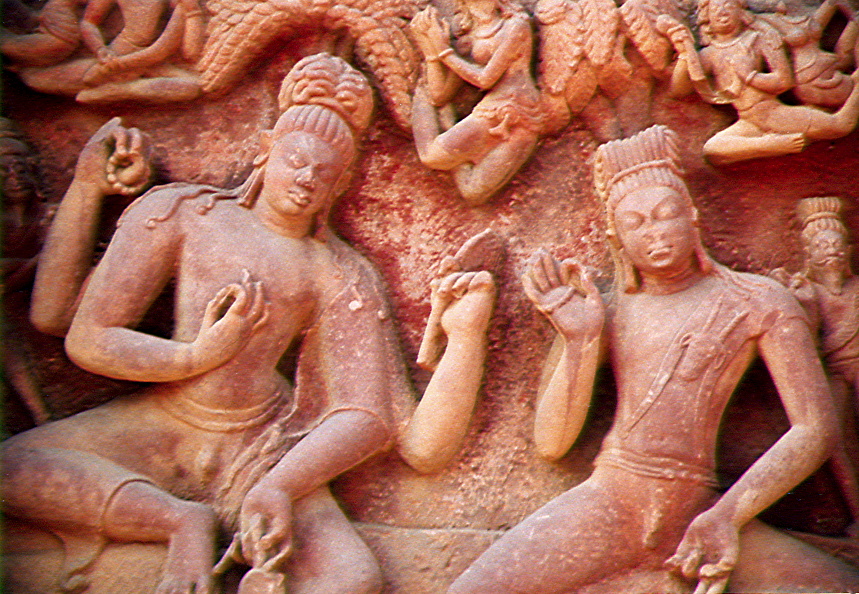
There is a story of the birth of Urvashi, the celestial nymph, an apsara, born from the divine sages, Nara and Narayana. At Badri, in the upper reaches of the high Himalayas, where mere mortals cannot go, the sages Nara and Narayana were in intense meditation.
The sages Nara and Narayana had taken to intense austerities in their practice of meditation from a very young age. They moved around in the upper regions of Kedar and Badri, and sometimes were known to frequent the upper passes to Gomukh, at the birth of the river Ganga. At this tri-junction of the sacred birth of several holy rivers, Nara and Narayana began to observe their most intense meditation. In entering nirvikalpa samadhi, they began to focus their entire powerful meditation energy upon the aspect of the supreme human, ascribed as 'tath'.
As they progressed in their meditation and austerities, other renowned sages and their disciples began to assemble in the lower valleys of modern day Gangotri, Yamunotri, Kedar and Badri. They were content in absorbing the emanating energies, powerful as they were, from Nara and Narayana. It is said, and it is thus seen, to this day and times, that the most aspiring of monks, sadhus, sages and practitioners journey to Gomukh and Kedar and travel beyond along the higher regions of the glaciers, to immerse themselves in meditation through the most intense winters and absorb the energy and vibrations in these regions.
The sages who had assembled in the lower valleys began to recognise the intensity of their meditation, and acclaimed Nara and Narayana, divine though they may be, as the most accomplished among them all. Being manifestations of Vishnu by themselves, for Sesha too is manifest from HIM alone, Nara and Narayana gained in their abilities to immerse themselves into intense samadhi and dhyana.
The intense energy emanating from Nara and Narayana began to spread beyond the upper reaches of the remote Himalayas and the lower valleys. Soon enough, the energy and vibrations began to be felt and recognised in the lands of the gods at Alaka, in that unseen regions of the uppermost of the mighty Himalayas that cannot be understood or visited by mortals.
The energy, intense as it was, soon engulfed the three worlds and overcome all aspects of known creation. In this unthinkable heat and the spread of energy, Indra, the king of the gods, got worried at Alaka. He knew of their identities, of the manifestation of Vishnu himself, as Nara and Narayana. He knew of their veneration by Shiva. He was worried that in their manifestation, their energy could become a threat to him, as king of the gods. How could he fight Vishnu, for was he not Nara and Narayana?
Indra decided that he would have to intervene and interrupt the austerities of Nara and Narayana. He journeyed out of his place, Amaravathi, at Alaka, and came to Sundamadana, the mountain in the Badri-Kedar region of the Himalayas. Knowing them to be manifestations of Vishnu, he thought of approaching the matter with diplomacy and veneration. He dared not face the wrath of Vishnu, if he would be angered on being disturbed at meditation.
He went up to the sages Nara and Narayana meditating upon the divine aspect of Devi, and saluted them and said, "O divine sages, O divinities yourselves, as Vishnu himself, I bow to thee. I am but a mere god, and do not compare myself to the both of you. But, since Shiva himself has declared his admiration for you and adores you from afar, it is only Brahma who can satiate you at your intense meditation. He, however, is divine grandfather to thee, and is fully aware of your energy. It is thus, left to me to acclaim your tremendous meditation, and declare my recognition, happy that you are immersed in your dhyana. I am most happy to grant you any boon that you may desire. O venerable sages, please step out of your meditation, and do ask."
Nara and Narayana were engrossed within their nirvikalpa samadhi, and jnanis that they were, immersed in their dhyana, did not even realise that Indra, the king of the gods was standing in their presence and was talking to them. Realising that his attempt at polite diplomacy was an utter failure, Indra decided to adopt other means. Initially, Indra created some paranormal visualisations that could enter the inner mind of meditative ascetics. These were powerless and were unable to penetrate even the outer minds of Nara and Narayana.
Having failed, Indra began to create primeval illusions of real-like external experiences. He created illusory animals that would take on real manifestations and would be dangerous and could create fear in mortals. These animals known for causing harm to humans, were established by Indra as real creatures in the vicinity of Nara and Narayana. The animals charged at the sages, but were thwarted by their divine auras. Being able to realise that Nara and Narayana were divine beings, the animals went away from the area.
The journey of a person, mortal or god, intent on repeatedly challenging his fate, cannot ever be content with reason, logic or dharma. It was thus with Indra also, despite being the king of the gods. He decided to seek the help of Kama, the God of Love, and his consort, Rati, the angel of Spring. He spoke thus, to Kama and Rati, "Go to Sundamadana, the mountain where the divine sages, Nara and Narayana, are immersed in intense austerities. Go with other apsaras. At the region of Kedar and Badri, you will find them, in solitude without any disturbances from anyone. They have withdrawn completely from the world in the valleys below and from the lands of the gods."
Instructing Kama further, Indra said, "You will have to be very clever. They are none other than Vishnu himself, as Nara and Narayana. Your usual arrows will probably be rendered useless. Even Eswara has seen his Pasupatastra become powerless against them. Perhaps love will succeed where weaponry cannot. How can Vishnu himself be against love that is devoid of enmity, anger or malefic intentions? Prepare your most powerful of weapons and use them on Nara and Narayana."
Kama was doubtful about following the instructions of Indra against the most powerful of gods. He thought back to how Shiva had incinerated him with his trinetra (= third eye) and Rati had to plead for his forgiveness. It required for both to be reborn and to redeem themselves to be united once again. He replied to Indra, "O King of the devas! I have to and will follow your orders. But, if you may recollect that on the earlier occasion, in obeying your orders, I had cast my arrows on Eswara himself, as he was engrossed in meditation. It took us, me and Rati, hundreds of years of redemption and rebirths, to be united again and to be together. I agreed on that occasion because the three worlds were threatened by Tripurasura, and it was essential that we protect creation as we knew it."
"But, there is no enemy that threatens the three worlds, or the devas, now," Kama pleaded, "And the two divine sages, Nara and Narayana, are immersed in very intensive austerities to preserve and spread righteousness, dharma, in the three worlds, in fulfillment of their responsibilities to their father. This is good for us, for mortals and for all creation. Why should we disturb them thus? And, if we do, I will have to face their anger and would again be separated from my beloved Rati."
Indra understood his fears and placated Kama, and said, "O Manmatha! O God of Love! You are the supreme archer to be sent out to rescue the three worlds through peace and love! There is none other than you! The three worlds are under threat, and it is from none other than Nara and Narayana themselves. The intensity and duration of their austerities and the spread of their energy from their meditation has spread all over and is beginning to consume the energy of the three worlds. It is much like an unexpected pralaya. They are not aware that their intention to do good by their dhyana has actually begun to threaten those whom they desired to help. It is but necessary for us to get involved and interrupt the meditation of Nara and Narayana."
"I understand your fear, O Kama, but it has to be done," said Indra, "You are the only warrior that we can send to stand up against Nara and Narayana, for you do not fight. This is the only way. You may adopt a different strategy this time. Take the most beautiful of my chosen apsaras with you, take Rambha, Tilottama, Menaka and also sixteen thousand other apsaras. Keep them between you and Nara and Narayana. Let them distract the divine sages when you disrupt their meditation with your arrows of love. O Manmatha, O Kama, it is only you who can save the three worlds now. Do not fail me. Let the apsaras singe in front of Nara and Narayana. Let them seduce them while you release your arrows at the divine sages. Let there be divine musicians who will accompany you and the apsaras. Let there be divine dances."
Thus encouraged, Kama arrived at Sundamadana, the mountain in the Badri-Kedar region of the Himalayas. Accompanied by Rati, also came Rambha, Tilottama and Menaka, the three celestial and eternally beautiful apsaras. Along with them came sixteen thousand apsaras, divine musicians and their accompanying entourage. The apsaras were only keen to obey the orders of Indra and were least concerned about Kama's worries or his knowledge of the prowess of Vishnu.
Rambha, Tilottama and Menaka saw it as an opportunity to challenge the celibacy of the divine sages, Nara and Narayana. When would they be able to get such a blessing again, they felt, for they were about to seduce Vishnu himself. Even if they were to fail, the opportunity itself would be the most tremendous blessing. If this was to be the method, then so be it. If they were to be cursed by the anger of Vishnu, then so be it.
On arrival at Sundamadana, the three celestial nymphs, Rambha, Tilottama and Menaka accompanied by the sixteen thousand apsaras began to sing and dance seductively. Divine music, divine instruments and the divine dances began to engulf the serene meditative energy at the mountain. Rati, the angel of Spring, contributed her effort, by causing flowers to bloom all around the mountains and their valleys, and soon enough, the intoxicating scents began to take over the slopes and peaks. Kama got five of his most potent arrows ready and waited for his opportunity.
Nara was disturbed. He opened his eyes and looked upon enquiringly, quietly, at all the happenings at Sundamadana. He did not get angry. He was just curious as to the cause of these events. These could not happen without a reason, and was not Narayana himself, the cause of all reasons? He looked at Narayana for guidance, who realising his predicament, came out of his own meditative trance. Narayana looked upon the events with his benevolent happiness, and did not get angry. He was happily calm and sat quietly and smiled, as only Vishnu, the all-knowing can.
Narayana spoke to Nara, thus, "Brother, it is but divine dancing, singing and music by divine apsaras. There, I can see Rambha, Tilottama and Menaka leading them. they have come here on the orders of Indra, and thus, they are not at fault. See, there, with them, are Kama, the god of Love, and Rati, his consort, the angel of Spring. For, how could the winter have been replaced by blossoming flowers and how could the mountains and valleys be covered with spring, in these days?"
Nara was astounded and puzzled. He enquired, unspokenly, for would not Narayana be able to hear the most silent of all prayers? He wondered, "Has the king of the gods become foolish enough to challenge Narayana? Was it not known that as Nara and Narayana, it was Vishnu himself who had undertaken to spread righteousness in the world? How did he get the courage to challenge Nara and Narayana in their austerities? And in so doing, how could Indra think of such a lecherous challenge to the sanctity and celibacy of the most foremost of all sages?"
Narayana smiled, raised his hand in blessing to all the uninvited visitors, and spoke to Nara, "It is not thus, Brother Nara! Indra is the king of the gods, and it is his responsibility to be the custodian of the three worlds. He would have to worry and consider some action even if it would be to interrupt, disturb or seek some solace against or from Brahma, Shiva or me. It is not for us to get angry against him. Let us welcome our visitors, bless them and see as to what is it that the plan is against us."
Saying thus, Narayana gestured with his hands, welcoming everyone with a smile. Kama, Rati, Rambha, Tilottama and Menaka accompanied by the sixteen thousand apsaras approached Nara and Narayana. They bowed in salutation and sought the blessings of Narayana. With happiness in his eyes, smilingly, Narayana blessed them all, and they were content. Realising that they still had their job, a task to be completed, the celestial nymphs began to dance and sing with seductive gestures and words. The beauty of the three nymphs was astounding and they seemed to glow and become more beautiful while dancing in front of Narayana.
All their attempts did not face any success against Nara and Narayana. As their dancing and singing continued, Narayana said thus to Nara, "See, they glow in their beauty, but they also grow in their ego and arrogance. They realise that after I have blessed them, they cannot be cursed by me. That I would not get angry with them. They have begun to show their triumph and take pride in their prowess and beauty. They are now showing their victory to Rati and all the sixteen thousand apsaras here. I will have to bring this to an end."
Kama and Nara heard Narayana speak thus. It was timely, for Kama realised that any sudden challenge could disturb Narayana away from the calmness that seemed to emanate from him. Quietly, Kama sheathed the five arrows of great potency and hid them. He bowed to Narayana in salutation and chose a location behind Nara. Rati saw this and understood the fragility of the moment and walked up to Narayana, bowed in salutation and stood alongside Kama.
Narayana conveyed his thoughts to Nara, unspokenly, for they were one in their soul and mind, "Brother Nara! These apsaras, Rambha, Tilottama and Menaka have begun to take too much pride in their beauty, seductive dancing and in their ability to seek the attraction of men. They do not realise that they are in the presence of sages who are intent on their meditation and austerities. They do not understand that this should not be extended in disturbing the meditation of sages. I will now put an end to this. I will now show them the power of meditation, dhyana and the ability of a sage. Beauty and charms are but transient achievements. They are like treasures that will disappear. They need to realise that the real achievement in life comes from exploring oneself from within. I shall create an apsara that would surpass them in their beauty and be better than the three of them in her abilities."
Saying thus, Narayana slapped his thigh and manifested a beautiful woman by his power and ability. Being born from the thigh (Uru = thigh, in Sanskrit), she was named Urvashi. She was far more beautiful than the three apsaras, Rambha, Tilottama and Menaka. After Urvashi, Narayana created several hundred beautiful women to be companions to her. Seeing Urvashi, all the apsaras stopped their dancing and singing. They were now ashamed that they had come to challenge Nara and Narayana.
They came together, bowed in humility, and asked for Narayana's forgiveness. They said, "Forgive us, O Narayana, for thou art supreme! We were misled by Indra, and in the accompaniment of Manmatha himself, we lost our integrity. We understand and now respect the power of meditation and bow to the intent of your celibacy. We do not wish to disturb your austerities. Please forgive us!"
Narayana blessed them all and declared that Urvashi could go back with Rambha, Tilottama and Menaka in order that Indra may see that he had nothing to fear. The sixteen thousand apsaras who had come with the three celestial nymphs did not wish to return to Alaka, for they had seen Narayana, had spoken to him and received his blessings. They were now deeply in love with Narayana and desired to stay back at Sundamadana and be wed to him.
Narayana smiled and declined, and spoke thus, "O ladies, you who are in love with me, I bless you all. At this moment, at Sundamadana, I am here to be immersed in my dhyana, along with my beloved brother, Nara. We are intent in continuing with our meditation and in practising our austerities. We wish to be accomplished as our father, Dharma, and we would like to stay undisturbed in our intent to spread righteousness in the world. I cannot accept you as you desire, in this period of celibacy."
"Go back to Indra, and do take our daughter, Urvashi, and all her sister companions with you," said Narayana, "Go back and tell Indra, that he has nothing to fear from us. In his fear, he has sent you all to disturb us. I cannot accept you all in marriage in my aspect as Narayana. I shall be born again, as Krishna, in the coming yuga, and so will Nara, be born as Arjuna, and we will be companions together in our battle to fight the forces against righteousness. You will all be born again, in the next yuga, all sixteen thousand apsaras together, and as Krishna, I shall wed you all. I promise you and bless you that we will be together. Take Urvashi and her companions with you and inform Indra about the sanctity of her birth."
[15.12.2013]