The first salutation in the Mahabharata of Krishna Dwaipayana Vyasa is to Nara and Narayana. Of course, as is explained later in the great epic, Arjuna is believed to be Nara as a companion to Narayana as Krishna. Maharishi Veda Vyasa offers his first salutation to Nara and Narayana before he embarks on his journey as an epic poet.

Nara and Narayana are regarded as the primordial manifestations of Vishnu, and are the incarnations, again and again, on this earth to uphold the aspect of dharma and are the embodiment of rightful living, rightful thought and rightful action. While Nara is the aspect of the human soul, the body is the companion and divine aspect as Narayana.
In the Mahabharata, Nara as Arjuna and Krishna as Narayana represent the aspects of inseparable knowledge and action. While the mortal Arjuna is thoughtful and hesitant, he is unquestioning in following the path of dharma through action, as shown by the divine Krishna. Finally when Arjuna hesitates on the battlefield, after having been instructed through the geetasaara, Krishna willingly shows the infinite vision of himself as Narayana. It is thus, in understanding the great play of the two companions, the divine teacher and his accepting pupil, that Veda Vyasa takes us to accept them as primarily eternal, as singularly divine and to be respected, before beginning to journey through the Mahabharata.

Maharishi Veda Vyasa leads us to first bow in salutation, accept the divinity of Krishna and Arjuna, as in the same breath as in worshipful humility to Ganesha and Goddess Saraswati. It is said that the Mahabharata was written at Mana, north of Badrinath in modern Uttarakhand, in the upper reaches of the Himalayas. The divine mortal aspect of Eswara himself, in his being as Adi Sankara is known to have discovered the divine deity and icon of Vishnu, in his manifestation as Narayana and installed thus, the sacred deity at Badri, and thereby accepted and venerated as Badrinath. Both, at Badrinath and neighbouring Kedarnath, the upper Himalayas here, are known to be the sacred home of Nara and Narayana. The twin forms of Nara and Narayana are thought to have led to the incarnation of Swaminarayan at Badrikashram.
There is mention that Nara is known as the 'primeval man or eternal spirit' in this universe, and always associated with Narayana. In various representations, Nara and Narayana are deities, or as at Kedarnath are divine sages, or in epics as mortal incarnations, such as in the Mahabharata, Harivamsa and various puranas. As Vishnu is Narayana, so is Nara considered to be his divine Sesha, the multiple-headed snake and his eternal companion.

There are various representations, in being different from each other as Vishnu and Sheshnaag, alike each other as Swaminarayan, as similar mortals with weapons and human lives as Krishna and Arjuna. As the fifth avatar of Lord Vishnu, they are also considered to be the two sons of Dharma, being the son of Brahma and his consort Ahimsa, as Murti, daughter of Daksha.
As divine sages, Nara and Narayana are known to habit the upper reaches of the hidden Himalayas where no normal mortal can reach, above Badri and Kedar. They meditate in these higher regions and conduct their austerities for the preservation of dharma, being born of their father.
There is a rare and little known story of how Nara and Narayana had to unite to fight and defeat a powerful enemy called Sahasrakavacha - he with a thousand armours. Sahasrakavacha is thought to have reincarnated as Karna in the Mahabharata, with divine armour - kavacha - and ear rings - kundala. And once again, Krishna and Arjuna had to unite to defeat Karna and kill him. Krishna is shown to be steadfast in the battle and never allows Arjuna to know that Karna is his elder brother, for if he would have known, the battle would not have been fought. Krishna knew of Karna's promise to Kunti, that he would kill only one Pandava, and she would continue to have five of her sons after the great battle at Kurukshetra.
There is a rarer story of the aspect of their encounter with Maheshwara at Kedar. Shiva knew that the divinity of Nara and Narayana was supreme, and he wanted this to be known to the three worlds. He arrived at the upper reaches of Kedar, and as Nara and Narayana, the divine sages were engrossed in their determined meditation and austerities, Shiva hurled the most dangerous of his astras - the Pashupatastra - at them. The most powerful of all weapons that the gods had ever known, lost all its potency in the face of its conflict with the intense meditation energy of Nara and Narayana. Thus did Shiva recognise them and proclaimed them to the three worlds that these divine sages, Nara and Narayana were jnanis of the highest order - and were declared as jnanis in eternal nirvikalpa samadhi.
[14.12.2013]
Notes about the image of Maharishi Veda Vyasa's salutations to Nara and Narayana and Goddess Saraswati
The image is from - http://upload.wikimedia.org/wikipedia/commons/c/ca/Mahabharata01ramauoft_0024_01.jpg
The URL mentions that the author is Shri Ramanarayanadatta Sastri, and the publisher of Volume 1 is Gorakhpur Geeta Press and that possibly the image is not in copyright. The digitising sponsor is the University of Toronto. The book is available as on 17.12.2013 at https://archive.org/details/mahabharata01ramauoft

Maharishi Veda Vyasa's salutation to Nara and Narayana and Goddess Saraswati
This image is from -
Notes about this image are given at the end of this blog post.
Nara and Narayana are regarded as the primordial manifestations of Vishnu, and are the incarnations, again and again, on this earth to uphold the aspect of dharma and are the embodiment of rightful living, rightful thought and rightful action. While Nara is the aspect of the human soul, the body is the companion and divine aspect as Narayana.
In the Mahabharata, Nara as Arjuna and Krishna as Narayana represent the aspects of inseparable knowledge and action. While the mortal Arjuna is thoughtful and hesitant, he is unquestioning in following the path of dharma through action, as shown by the divine Krishna. Finally when Arjuna hesitates on the battlefield, after having been instructed through the geetasaara, Krishna willingly shows the infinite vision of himself as Narayana. It is thus, in understanding the great play of the two companions, the divine teacher and his accepting pupil, that Veda Vyasa takes us to accept them as primarily eternal, as singularly divine and to be respected, before beginning to journey through the Mahabharata.

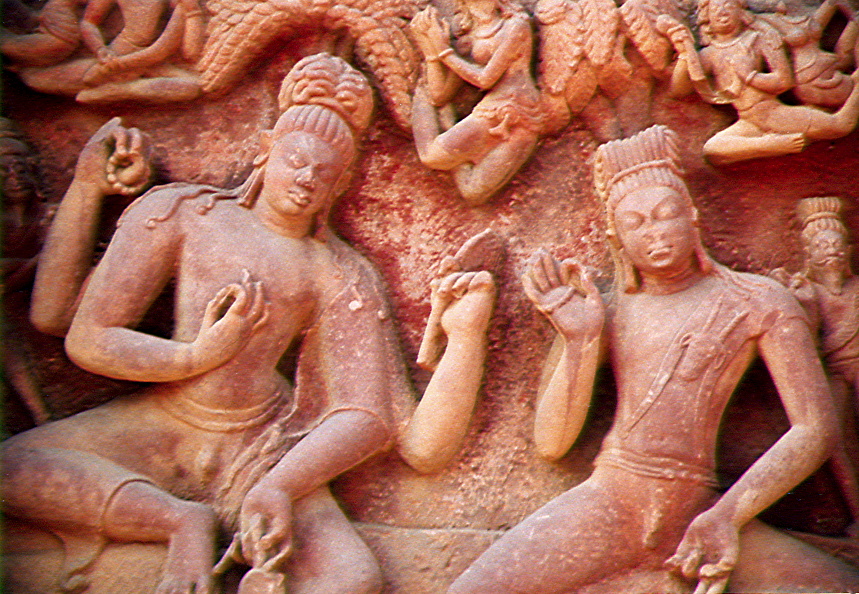
Nara and Narayana
from a sculpture at Deogarh, Uttar Pradesh c. 5th Century
Under Creative Commons Attribution at Wikipedia
Maharishi Veda Vyasa leads us to first bow in salutation, accept the divinity of Krishna and Arjuna, as in the same breath as in worshipful humility to Ganesha and Goddess Saraswati. It is said that the Mahabharata was written at Mana, north of Badrinath in modern Uttarakhand, in the upper reaches of the Himalayas. The divine mortal aspect of Eswara himself, in his being as Adi Sankara is known to have discovered the divine deity and icon of Vishnu, in his manifestation as Narayana and installed thus, the sacred deity at Badri, and thereby accepted and venerated as Badrinath. Both, at Badrinath and neighbouring Kedarnath, the upper Himalayas here, are known to be the sacred home of Nara and Narayana. The twin forms of Nara and Narayana are thought to have led to the incarnation of Swaminarayan at Badrikashram.
There is mention that Nara is known as the 'primeval man or eternal spirit' in this universe, and always associated with Narayana. In various representations, Nara and Narayana are deities, or as at Kedarnath are divine sages, or in epics as mortal incarnations, such as in the Mahabharata, Harivamsa and various puranas. As Vishnu is Narayana, so is Nara considered to be his divine Sesha, the multiple-headed snake and his eternal companion.

Nara and Narayana
from a sculpture at Deogarh, Uttar Pradesh c. 5 Century
Under Creative Commons Attribution at Wikipedia
There are various representations, in being different from each other as Vishnu and Sheshnaag, alike each other as Swaminarayan, as similar mortals with weapons and human lives as Krishna and Arjuna. As the fifth avatar of Lord Vishnu, they are also considered to be the two sons of Dharma, being the son of Brahma and his consort Ahimsa, as Murti, daughter of Daksha.
As divine sages, Nara and Narayana are known to habit the upper reaches of the hidden Himalayas where no normal mortal can reach, above Badri and Kedar. They meditate in these higher regions and conduct their austerities for the preservation of dharma, being born of their father.
There is a rare and little known story of how Nara and Narayana had to unite to fight and defeat a powerful enemy called Sahasrakavacha - he with a thousand armours. Sahasrakavacha is thought to have reincarnated as Karna in the Mahabharata, with divine armour - kavacha - and ear rings - kundala. And once again, Krishna and Arjuna had to unite to defeat Karna and kill him. Krishna is shown to be steadfast in the battle and never allows Arjuna to know that Karna is his elder brother, for if he would have known, the battle would not have been fought. Krishna knew of Karna's promise to Kunti, that he would kill only one Pandava, and she would continue to have five of her sons after the great battle at Kurukshetra.
There is a rarer story of the aspect of their encounter with Maheshwara at Kedar. Shiva knew that the divinity of Nara and Narayana was supreme, and he wanted this to be known to the three worlds. He arrived at the upper reaches of Kedar, and as Nara and Narayana, the divine sages were engrossed in their determined meditation and austerities, Shiva hurled the most dangerous of his astras - the Pashupatastra - at them. The most powerful of all weapons that the gods had ever known, lost all its potency in the face of its conflict with the intense meditation energy of Nara and Narayana. Thus did Shiva recognise them and proclaimed them to the three worlds that these divine sages, Nara and Narayana were jnanis of the highest order - and were declared as jnanis in eternal nirvikalpa samadhi.
[14.12.2013]
Notes about the image of Maharishi Veda Vyasa's salutations to Nara and Narayana and Goddess Saraswati
The image is from - http://upload.wikimedia.org/wikipedia/commons/c/ca/Mahabharata01ramauoft_0024_01.jpg
The URL mentions that the author is Shri Ramanarayanadatta Sastri, and the publisher of Volume 1 is Gorakhpur Geeta Press and that possibly the image is not in copyright. The digitising sponsor is the University of Toronto. The book is available as on 17.12.2013 at https://archive.org/details/mahabharata01ramauoft